Rally to Read is Reading Is Fundamental's nationwide initiative that inspires families, educators, and communities to read together. Each month, Rally to Read offers a new theme, book lists, and read-aloud videos to help bring stories to life. Read-alouds are one of the simplest tools families and teachers have for building a child's love of reading and reading comprehension, and research shows that a few easy habits, even the way you go about reading a book, can make story time even more powerful.
What Makes a Read-Aloud Effective?
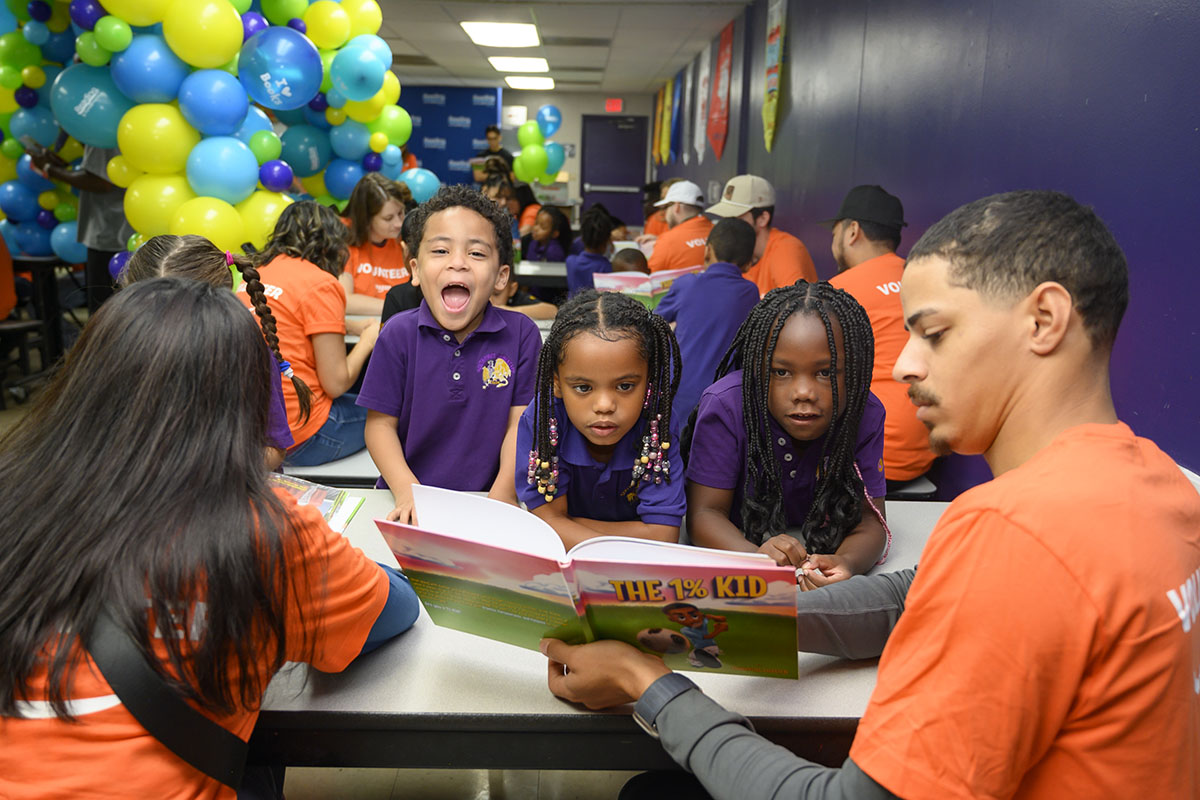
A read-aloud works best when there is back-and-forth talk, not just words on a page. Dr. Jill Pentimonti, a researcher and member of RIF's Early Childhood Literacy Advisory Board, explains that the real value comes from the questions you ask, the letters you point out, and the sounds you notice together. Simply flipping through the pages and reading the words is not what makes the biggest difference. It is the conversation that happens around the story.
Pentimonti groups this interaction into three focus areas. The first is listening comprehension, an early building block of reading comprehension, which grows when you ask questions like “What do you think happens next?” The second is print knowledge, which means pointing out letters and showing how books work, like the direction words move across a page. The third is language sounds, which means noticing rhymes and syllables together. You do not need to cover all threeevery time you read. Pick one or two things to focus on and mix it up from book to book, so the story stays fun and does not feel like a quiz.
A simple trick that works for both families and teachers is to flip through a book before reading it out loud and mark a page or two with a sticky note, maybe one for a great vocabulary word and another for bold, colorful print worth pointing out. This kind of light planning takes only a minute or two but makes the read-aloud far more effective.
What Kinds of Books Should You Choose?
A good mix of books means combining stories with information books, alphabet books, and rhyming books. Research shows that children hear narrative stories about 95% of the time, which leaves little room for other types of books that build different skills. Think of it the way you think about a balanced meal. Kids need a mix, not just one kind of book over and over.
Fiction books are great for teaching story structure and new words. They make it easy to talk about what happened at the beginning, middle, and end of a book, a hard concept for a young child to grasp without an example in front of them. Information books, like ones about dinosaurs, ladybugs, or rocks, introduce bolded words, labels, and layouts that children will see again in school textbooks once they move from learning to read into reading to learn, along with exciting technical vocabulary kids love to master.
Alphabet books reinforce letter names and rhyming books build the sound skills children need to read later on, since sounding out a word depends on hearing how sounds blend together. Books about emotions and books that reflect different cultures and life experiences give kids new words to talk about their feelings and the world around them. Mixing all of these formats gives kids a fuller foundation for both reading comprehension and joy in reading.
Why Should You Reread the Same Book?
Rereading gives children a new chance to notice something different each time, and it is one of the most useful tools families and teachers have. On the first read, kids are mostly following the story, so it works well to ask fewer questions and save predictions for that first pass, since a prediction only works if the child does not already know the ending.
On later reads, once kids already know what happens, you can shift the focus, maybe pointing out cool print on the second read and sounds on the third. Reading a book more than once is not something to avoid, even if it feels repetitive to the adult. It is a chance to teach something new each time, and it builds kids' confidence with the story, the words, and the skills hiding inside it.
How Can You Support or Challenge a Child During a Read-Aloud?
You can support a child by narrowing the choices, and challenge them by asking questions that require more thinking. Knowing when to use each approach makes a big difference in the moment.
Start with an open-ended question to give children space to think, share ideas, and use their own words. If a child needs support answering, you can offer a scaffold. For example, follow “Where is he going?” with “Do you think he’s going to the store or to school?” You can also model the answer out loud, saying something like “That's a tricky one, but I noticed he packed his school bag, so I think he's going to school,” then invite the child to repeat the idea with you. These small moves build confidence and give kids practice using language, which especially helps young children and multilingual learners who may not yet have the words to answer an open-ended question on their own.
When a child is ready for more complex questions, such as making predictions, you can ask “why do you think that happened?” These prompts push them to connect ideas and use longer sentences. These questions ask kids to pull together several pieces of information at once, which is great practice for both language and reading comprehension. Connecting a story to something in a child's own life, like a recent trip to the zoo or a shared memory, also helps new ideas stick, since it links new knowledge to something kids already understand.
How Can You Start Tonight?
Start by picking a book with a purpose, flipping through it first, and choosing one or two things to focus on, like a new word, a fun letter, or a prediction question. You do not have to read an information book from start to finish. It is perfectly fine to use the table of contents and skip straight to the page about a favorite dinosaur.
For very young children, it is also fine to skip words entirely and simply talk about the pictures, since what matters most at that age is back-and-forth attention, not a word-for-word reading of every page. The goal is not a perfect checklist. It is a joyful, interactive habit that helps build the skills kids need to become confident readers.
Ready to put these strategies into practice? Rally to Read offers two free read-aloud videos every month from October through March, giving families and educators an easy way to bring these strategies to life together. Explore this month’s Rally to Read theme and our year round resources to get started.